

"It is not a tragedy of Jews or Roma, but of the entire mankind"
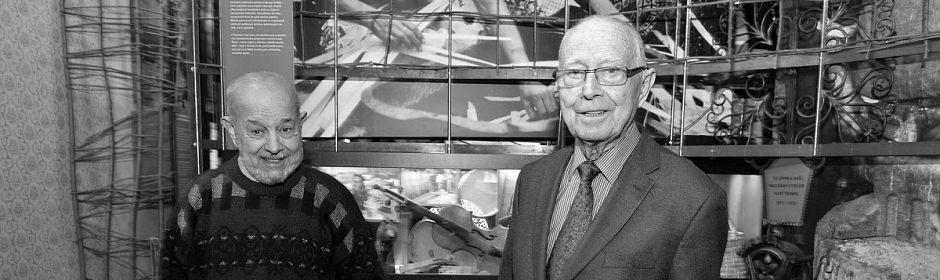
On the occasion of the seventieth anniversary of the end of the Second World War, we are also remembering the Holocaust. We talked with two of its survivors about the times then and nowadays.
Neo-Nazis want to march through Brno again on the first of May. What do you think about it?
Pavel Fried: Such people exist in every society. Personally, I feel sorry for them; some of their attitudes are an expression of their human folly. In any case, it is necessary to fight back against similar manifestations of intolerance, as we managed to do in 2011.
Karel Holomek: At the junction of Cejl Street and Malinovského Square, there was a great mass of people headed by students and young people, and also local Roma. Thus, for the participants of this blockade it is certainly not true, but most people will never learn. This is also given by the fact that sometimes we have only the dimmest awareness about modern history. People do not remember any longer what consequences hatred has.
Both of you experienced them firsthand.
KH: I was only five years old when transports of Protectorate Roma to Auschwitz began in March 1943, hence I perceived the whole situation only remotely. But I remember we always travelled somewhere. Later I learned that it was because my mother always got a warning from the local constable when a raid was about to take place, so she could take us away for a while. She alone was not a Roma, which saved my and my sister's lives.
My father, who had a degree in law, managed to escape from the Nazis to Slovakia. But I remember how my father's family, my grandparents and uncles, disappeared all of a sudden from one day to another. They lived in a settlement called Hraničky near Svatobořice, where my grandfather was Vajda ("Duke"), or Tchibali, as the Moravian Roma would say.
PF: I spent more than three years in Theresienstadt, where I got when I was less than twelve years old. The living conditions there were appalling, about thirty-five thousand people lost their lives in the Theresienstadt ghetto following its establishment in late 1941, among them was also my grandmother. They died mainly of infectious diseases or malnutrition; in fact, a compound planned for seven thousand people was in certain moments jam-packed with sixty thousand inmates.
In this "waiting room" before Auschwitz, you still could win at least somewhat bearable life, even though we had to do with just a quarter of bread a day. In Theresienstadt, Jews were gathered before being transported to the east, therefore the regime there was more moderate than in the extermination camps. In fact, it is a multifaceted problem to kill six million people: for example, you have to make the victims get peacefully onboard the railway carriages and then come as far as the front doors of the gas chambers. The Nazis therefore kept them in the belief that if they did not rebel, they would survive somehow.
Most of us were finally included in the transport. Before that, we were all shivering, nobody knew where the trains would really go. We suspected, however, that there was no return. This fate befell my sister and her husband, who died on 8 March 1944 in an Auschwitz gas chamber. On that day, almost four thousand Czech Jews were killed there.
Can one return to normal life after all that?
PF: Even now, as we speak, I see myself in Theresienstadt. These experiences also enter into our dreams. None of the people who survived a concentration camp, has ever got really back from there. They speak in schools, where they tell students about these things, and sometimes they just cannot resist emotion when they get too immersed into their memories.
Indeed, the return home was not easy. People were surprised, often unpleasantly, when a person appeared in the doorway after years away. Our flats were not left empty, nor were our belongings left unused. When my father returned, the district governor received him and seated him into armchairs that after our deportation disappeared from our apartment. But we didn't care about these things then, the only thing we wanted to know was whether at least some of our loved ones would return. Unfortunately, none of my five aunts, their husbands and cousins survived.
KH: Of the six and a half thousand deported Moravian Roma, only a few hundred returned. The Slovakian Roma, who at that time came here for work, were allocated vacant flats after expelled Jews or Germans. They got into an uprooted environment where after the war not one of the original inhabitants remained.
So, who are the Brno Roma?
KH: The original Moravian Gypsies lived only in the countryside, worked as labourers in seasonal work and traditional crafts such as blacksmithing, knife sharpening or pottery. For example, my grandfather was a horse trader. Thus, they played their own role in rural life and were integrated into it.
Nowadays, about fifteen to twenty thousand Roma live in Brno, who are almost without exception descendants of post-war immigrants from Slovakia. Most of them live rather at the bottom of society, but a part of the Brno community is also a group of Roma intellectuals. And we also have the Museum of Roma Culture, a unique institution even on an international scale. Hence, the coexistence of Roma and the majority is in principle more harmonious here than in some other locations of the Czech Republic.
And what is the life of the Brno Jewish community like nowadays?
PF: First and foremost, of course, it is much smaller than the Roma community. Before the war, twelve thousand Jews lived in Brno, and a large part of the business and cultural elite of the city adhered to the Jewish faith. Nowadays, our community has approximately three hundred members. Most of our members live in mixed marriages with other believers, and I am afraid that only some of their children will become Jews.
This implies the today's significance of the community for the city, which is rather just cultural and symbolic. Our community represents a certain memento, a reminder of the tragic history. We maintain what has been left after Jews here, abandoned cemeteries and synagogues in Brno and outside. And we care about those seniors who experienced the Holocaust, so that they can enjoy a dignified autumn of their lives.
What exactly constitutes this memento? What should we take from the tragedy of the Holocaust for the present?
PF: First of all, we must realize that the Holocaust is not only a tragedy of Jews or Roma, but of the entire mankind. It is a human failure, which can occur anytime and anywhere. It is frightening to see how quickly, under certain conditions, human life loses its value and sacred nature.
KH: The Holocaust is a warning of what intolerance eventually leads to. But to learn a lesson from this tragedy, we must also acknowledge its circumstances that we are not uncomfortable with. I survived the war thanks to many people who helped us. On the other hand, some Czechs also stood on the side of the perpetrators of the Holocaust, and many people approved of the so-called final solution.
The Holocaust must be discussed. Just laying wreaths routinely and not talking about it anymore would be hypocrisy. It is our duty to the victims of the Holocaust to try to understand how such a thing could happen at all. In recognition of this, unfortunately, our society is only at the very beginning.
Jaroslav Ostrčilík
Pavel Fried
was born in 1930 in Třebíč in the family of a hardware shop owner. After the war, he lived in Brno and studied mechanical engineering at the University of Technology. From 2004 he was the chairman and now is the vice-chairman of the Jewish community in Brno.
Karel Holomek
(* 1937 in Brno) is also a mechanical engineer by profession. In 1981 he was briefly imprisoned as a dissident for subversion; after 1990, he was an MP in Czech National Council. He is one of the founders of the Museum of Roma Culture, the honorary president of the Society of Roma in Moravia, and editor of the fortnightly magazine Romano hangos.


